

In wealth management, reporting has never looked better.
Dashboards are cleaner. Reports are more visual. Data is more accessible than ever.
And yet, many advisers still find themselves asking the same question:
How quickly and confidently can we get to what is actually driving portfolio outcomes?
Because while reporting has improved significantly, the process of getting to deeper understanding can still take time.
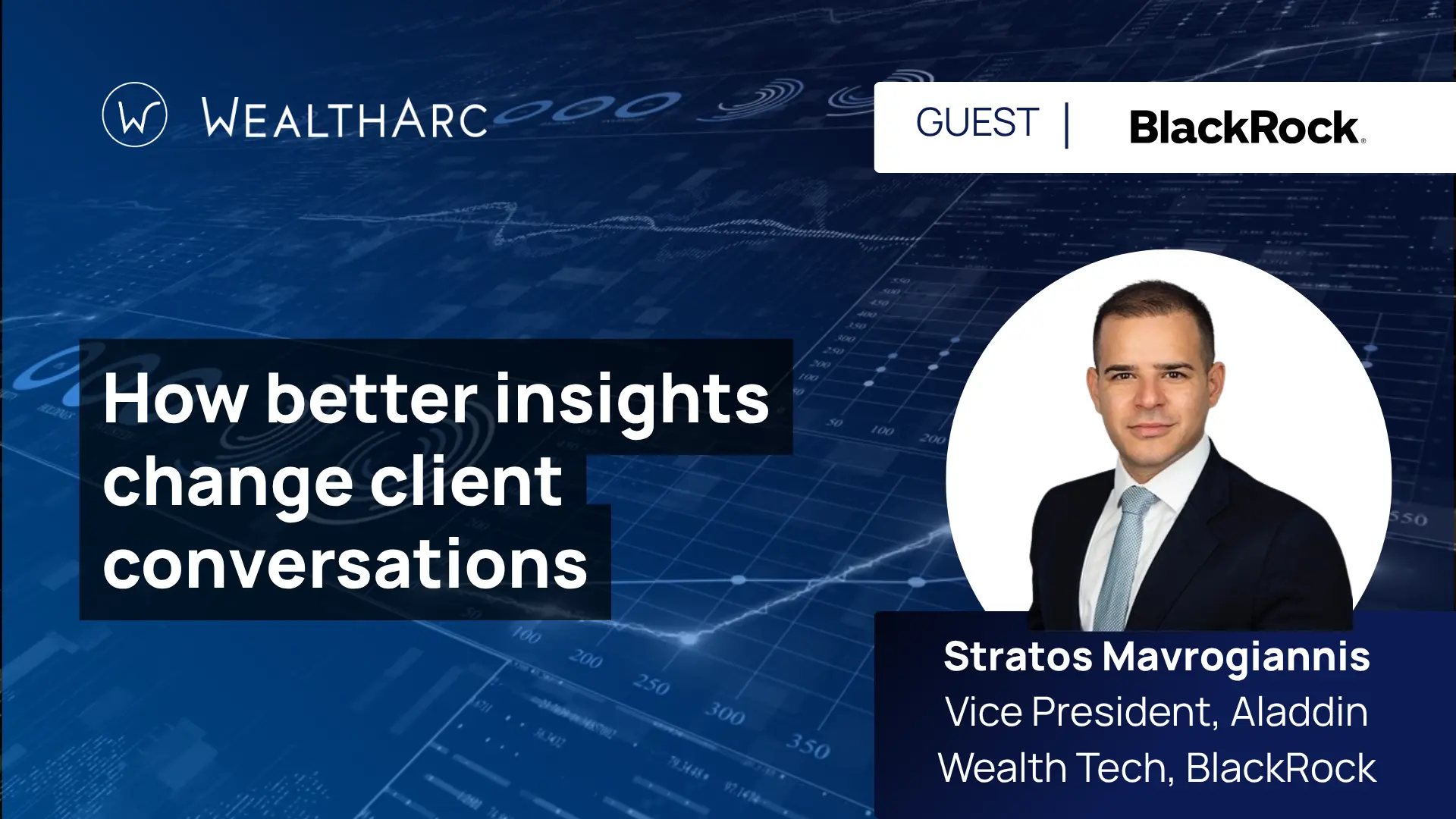
In Episode 2 of our From Data to Decisions series, Dennis Hagander, Sales Director at WealthArc, sits down with Stratos Mavrogiannis, Vice President, Aladdin WealthTech at BlackRock, to explore how wealth managers can move beyond reporting portfolios to accessing deeper insight more efficiently.
🎥 Watch Episode 2 embedded here:
Disclaimer: This content is for professional clients and qualified investors only. The views expressed are those of the speakers and do not constitute investment advice or a recommendation to buy or sell any financial instruments.
Reporting vs understanding: what is the difference?
At first glance, reporting and understanding can seem interchangeable.
But in practice, they are fundamentally different.
As Stratos explains:
“Reporting is descriptive. Understanding is interpretive.”
A report can be accurate, well-designed, and comprehensive. But getting to insight often requires additional analysis.
Many portfolio reports today are effectively well-presented snapshots:
- Performance figures
- Asset allocations
- Exposures
- Historical returns
They describe what has happened, but understanding why it happened, and what it means going forward, often sits in the interpretation that follows.
As we explored in Episode 1: Why trusted data is the foundation of wealth management analytics, clean, reconciled data is the starting point. Once that foundation is in place, the next step is making it easier to translate that clarity into insight.
Even with best-in-class reporting, many wealth managers still spend significant time connecting the dots across datasets and views to build a full picture.
That is where the next phase begins.
🏆 WealthArc was awarded Best Client Reporting Tool by WealthBriefing European Awards 2026. But we believe reporting is just the starting point. That’s why we give our clients one-click access to BlackRock Portfolio 360 to deliver deeper portfolio insight.
The risk of analyzing portfolios in silos
One of the biggest limitations in traditional portfolio reporting is that data is often analyzed in isolation.
Performance, risk, and exposure are frequently reviewed as separate components, rather than as interconnected drivers.
This creates blind spots.
For example:
- A portfolio may show strong performance, but be heavily exposed to a single market risk
- It may appear diversified across regions or sectors, but still underperform in volatile conditions
- A low-risk profile may protect against downside, but also limit upside opportunities
When these elements are assessed separately, the insight is still there, but it takes more effort to surface.
As Stratos highlights, the real value comes from understanding the relationships between risk, performance, and exposure, not just reviewing them individually.
Why context matters more than ever
Modern portfolios are more complex than ever before.
They span multiple asset classes, geographies, currencies, and macroeconomic influences.
In this environment, context becomes critical.
Wealth managers need to understand not just:
- What the portfolio holds
- How it has performed
But also:
- What factors are driving that performance
- How different exposures interact
- How the portfolio behaves under changing market conditions
From static reports to connected insights
By connecting clean, structured portfolio data from WealthArc into Portfolio 360, wealth managers gain the ability to analyze portfolios across multiple dimensions simultaneously.
This includes:
- Portfolio characteristics
- Risk exposures
- Performance drivers
- Stress testing scenarios
More importantly, these insights are connected, not siloed.
Instead of spending time reviewing separate reports, advisers can quickly move to understand how different elements of the portfolio interact with one another.
This is the shift from manual interpretation to more immediate insight.
As Dennis puts it:
“That’s when advisers start seeing the drivers behind outcomes, not just the outcomes themselves.”
How deeper insight improves investment decisions
One of the less obvious benefits of deeper portfolio insight is the ability to reduce noise.
In volatile markets, not every movement is meaningful.
But without context, every fluctuation can feel significant.
This can lead to:
- Reactive decision-making
- Unnecessary portfolio changes
- Increased emotional pressure on advisers
With the right data and analytics in place, wealth managers can filter out irrelevant signals and focus on what truly matters.
This leads to:
- Clearer decision-making
- Better alignment with client objectives and risk tolerance
- More disciplined portfolio management
From reactive reporting to proactive portfolio management
When insight replaces reporting as the focus, the role of analytics becomes a strategic advantage.
Firms can move from:
- Assembling reports to interpreting portfolios
- Validating numbers to making decisions
- Reacting to outcomes to shaping them
At this point, portfolio management becomes more proactive, more confident, and more aligned with long-term client goals.
Key takeaways for wealth managers
The conversation highlights a clear shift taking place across the industry: once best-in-class reporting is in place, the key differentiator is elevating your understanding.
Best-in-class reporting is the foundation, not the end point
Well-designed reports bring clarity and consistency to portfolio data. But on their own, they do not fully explain what is driving outcomes or what actions should follow.
Portfolio insights come from relationships, not isolated data points
Understanding how risk, performance, and exposure interact is essential for making informed decisions.
Context is critical in modern portfolio management
Without context, data can be misleading. With context, it becomes actionable.
Connected analytics unlock deeper portfolio insight
Integrating clean data with advanced analytics tools allows wealth managers to move from static reporting to dynamic portfolio evaluation.
Scenario analysis creates a forward-looking advantage
Testing portfolios under different market conditions enables better risk management and more resilient investment strategies.
Questions wealth managers should ask about their portfolio insights
For many firms, the challenge is not a lack of expertise or access to data. It is how much time and effort is required to turn that data into clear, actionable insight.
These questions can help assess your current approach.
Do our reports explain what is happening, or simply describe it?
If reports focus on outputs without explaining drivers, deeper insight may be missing.
Are we analyzing portfolio components in isolation?
Reviewing performance, risk, and exposure separately can create blind spots.
Can we clearly explain what is driving portfolio outcomes to clients?
If explanations feel uncertain or overly complex, underlying insights may be lacking.
Are we testing how portfolios perform under different market scenarios?
Without scenario analysis, portfolios are being assessed based on history rather than resilience.
How much time is spent preparing reports versus analysing them?
If most time goes into assembling data rather than deriving insights from it, the process may need to evolve.
Do we have a connected view of portfolio data across systems?
Disconnected tools often limit the ability to see the full picture.
Continue the journey from data to decisions
So far in the series:
- Episode 1: Why trusted data is the foundation of wealth management analytics
- Episode 2: From portfolio reporting to true understanding
Next, we explore how these insights ultimately impact what matters most: client relationships.
- Episode 3: How better insights transform client conversations (coming next)
Build deeper portfolio insight with WealthArc
As wealth management evolves, the ability to understand portfolios, not just report on them, is becoming a key differentiator.
WealthArc enables firms to:
- Consolidate and structure portfolio data across custodians
- Create a trusted data foundation for analysis
- Integrate seamlessly with advanced analytics tools such as BlackRock Portfolio 360
- Move from fragmented reporting to connected portfolio insight
With the right data and analytics in place, wealth managers can spend less time interpreting outcomes and more time making confident, forward-looking investment decisions.
👉 Book a conversation with the WealthArc team to explore how connected data and analytics can transform how you understand and manage portfolios.
Disclaimer: References to BlackRock and Aladdin Wealth are for informational purposes only. This content does not constitute investment advice or a recommendation. All opinions expressed are those of the speakers.
.webp)




















.jpg)


.jpg)
.jpg)

.png)

.png)
.png)


.png)

.png)

