.webp)

Whether one considers crypto assets a financial revolution, a speculative detour, or simply a highly volatile experiment in market design, one fact remains difficult to ignore: they became a part of the investment landscape. As such, it is generally more useful to understand and model them properly than to dismiss them outright.
In response to our Clients requests, WealthArc now supports Crypto Assets as part of its platform offering, enabling Clients to maintain clear, structured, and auditable crypto positions alongside traditional asset classes.
Further details on the scope of this implementation are outlined below:
- Crypto Custodians – Data Feed Support
- CoinGecko Integration
- Crypto Modelling
- Support for Manual Portfolios
Crypto Custodians
To support reliable pricing and custody data, WealthArc has integrated with the following Crypto Custodians:
- Tetra Trust
- Anchorage Digital
- BitGo
Although not a typical Custodians those companies are primarily focused on custody, infrastructure, and asset servicing, not traditional banking activities like retail deposits, lending, or payments.
These data sources are fully integrated into the WealthArc Data Feed ecosystem, allowing Clients to request connectivity and enable automated data ingestion where required.
CoinGecko Integration
WealthArc also integrates with CoinGecko, a leading provider of crypto market data. This enables access to more than 17,000 crypto assets, ranging from established instruments such as Bitcoin, Ethereum, Tether, XRP, Solana, and USDC to stablecoins, niche tokens, and even the occasional meme asset.
In short, if it is traded and has a market price, it can be represented in the system.
Crypto Modelling
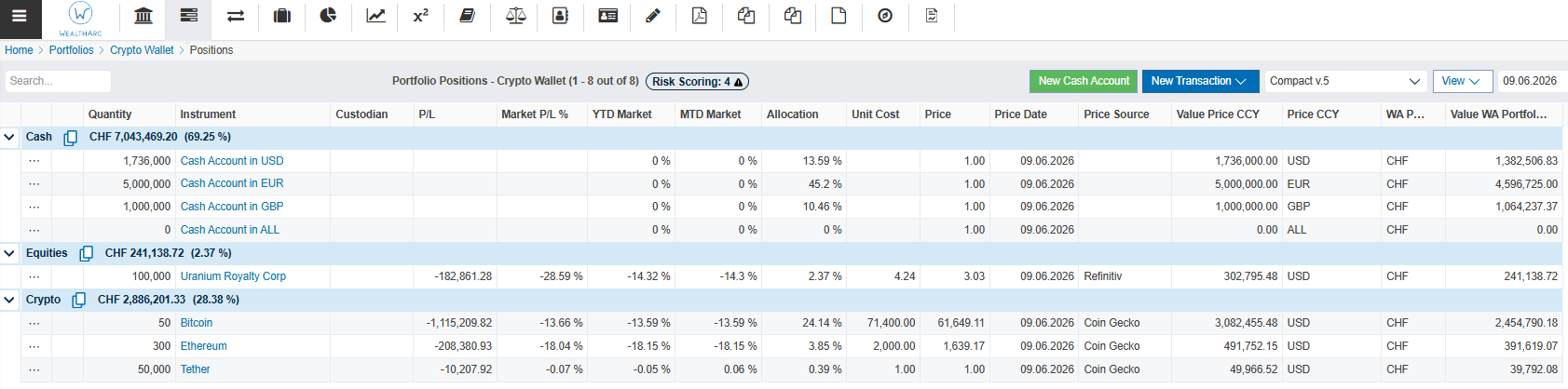
Within WealthArc, crypto assets are treated as a distinct asset class rather than “crypto currencies” in the traditional sense. Consistent with the view that they behave more like high-risk, high-volatility financial instruments, they are modelled separately from both cash accounts and standard financial instruments.
Crypto positions are expressed in native token quantities, while valuation is always presented in a fiduciary currency (e.g. USD). A typical position is represented as follows:
- Instrument: Bitcoin
- Crypto Symbol: BTC
- Quantity: 3.176 BTC
- Price: 80,359.02 USD
- Position Value: 255,220.25 USD
In addition, the following crypto-specific attributes are supported:
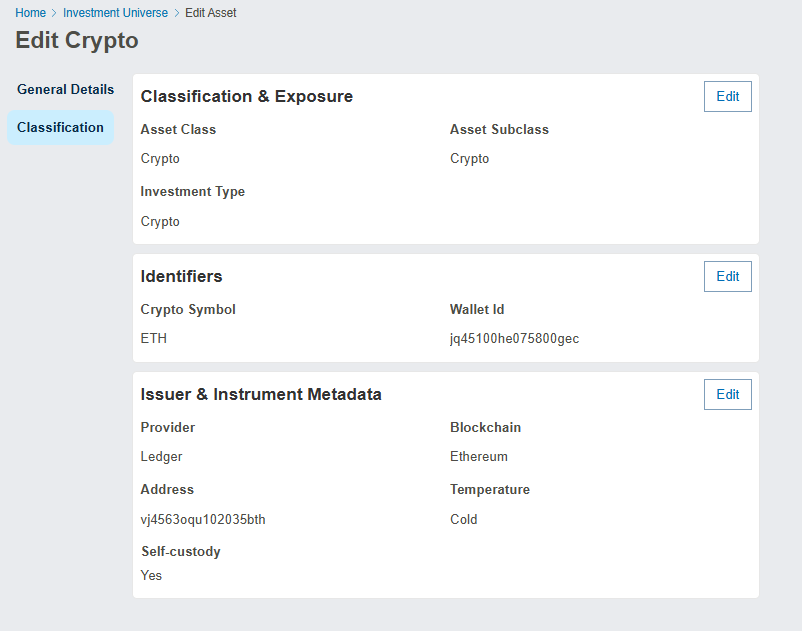
- Crypto Symbol – Identifier used for valuation and mapping
- Wallet ID – Wallet in which the asset is stored
- Address ID – Blockchain address associated with the asset
- Provider – Custody or storage provider
- Ledger – External or internal accounting system reference
To align crypto industry conventions with traditional portfolio structures, WealthArc applies the following mapping:
- Vault ID → Portfolio (can contain multiple crypto positions)
- Wallet ID → Position (holds a single crypto position)
- Address ID → Instrument attribute (reference updated through transactions)
Accordingly, if the same asset (e.g. Bitcoin) is held across multiple wallets or addresses, it will be represented as separate positions, each with its own instrument-level attributes.
New Manual Transaction Type: Staking Rewards
WealthArc now supports a dedicated Staking Rewards transaction type, complementing existing manual transactions such as Buy, Sell, and Asset Transfer.
This functionality enables users to record staking rewards directly within their crypto portfolios in a structured and auditable way.
To create a staking reward, open Add Manual Transaction, select Staking Rewards, choose the relevant crypto asset, and enter the quantity of tokens received. The system allows users to manually input or automatically retrieve the token price and FX rate, with transaction values calculated automatically and available for adjustment where required.
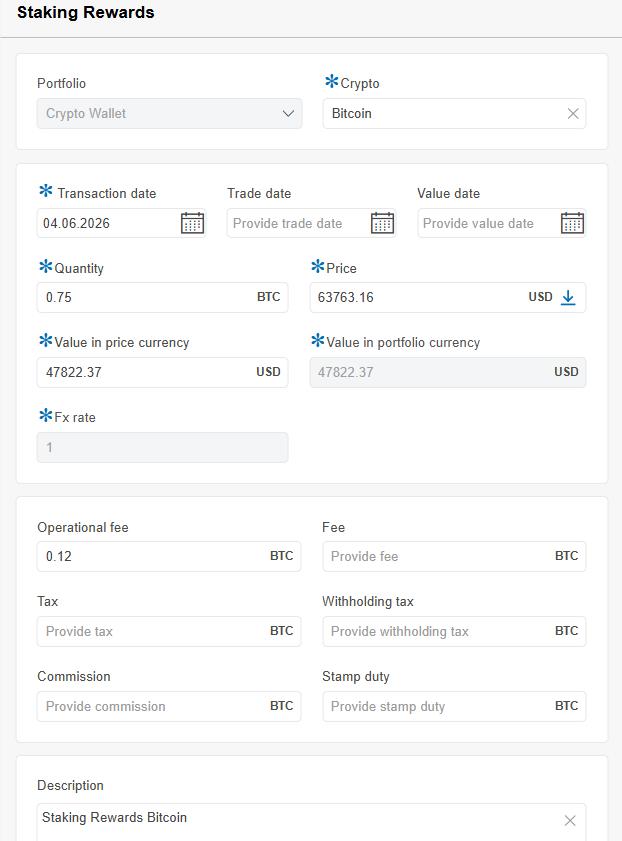
The transaction behaves similarly to the Interest transaction type, with one key distinction: both rewards and associated fees or taxes are recorded in crypto units and settled directly against the crypto position rather than a cash account. As a result, the rewarded quantity increases position holdings, while fees and taxes reduce the final position.
Supported deductions include operational fees, commissions, taxes, withholding taxes, and stamp duty. Each entry generates a separate transaction type, ensuring full traceability and auditability.
This approach provides a structured and transparent way to capture staking activity, eliminating the need for generic transaction workarounds while improving consistency of portfolio reporting.

























.jpg)


.jpg)
.jpg)

.png)

.png)
.png)


.png)

.png)

